

Pool water can look fine one day, then turn cloudy or green the next.
If you’re asking what does stabilizer do for a pool, the problem may be chlorine disappearing too fast in the sun.
That makes it feel like your chlorine is not working, even after you keep adding more.
Pool stabilizer helps protect chlorine so it lasts longer and keeps cleaning.
In this guide, you’ll learn what pool stabilizer does, how much you need, and how to add, raise, or lower it the right way.
Key Takeaways
- Pool stabilizer protects chlorine from sunlight, helping it stay in the water longer and keep your pool clean.
- Without enough stabilizer, chlorine can burn off within hours, which can lead to cloudy water, algae, and constant chemical adjustments.
- The ideal pool stabilizer level is usually 30–50 ppm for most pools, giving chlorine protection without making it less effective.
- Low stabilizer makes chlorine disappear too fast, while high stabilizer can weaken chlorine’s cleaning ability even when chlorine levels look normal.
- Always test your pool water before adding stabilizer, since raising stabilizer is easy, but lowering it often requires draining and refilling water.
- Add granular stabilizer slowly using the sock method, keep the pump running, and retest after 2–3 days before adding more.
What Is Pool Stabilizer?
A pool stabilizer is a chemical that helps your chlorine last longer in the water. It’s also called pool conditioner, and its main job is simple: to protect chlorine from the sun.
Without a stabilizing, UV rays from sunlight break down chlorine very quickly. That means even if you add chlorine, it can disappear within hours, leaving your pool unprotected.
Think of it like this: chlorine is doing the cleaning, but the stabilizer is what keeps it alive long enough to work.
Most pools, especially outdoor ones, need the right level of stabilizer to keep water clear and safe. If it’s missing, you’ll keep adding chlorine but won’t see consistent results.
What Is Pool Stabilizer Made Of?
Pool stabilizer is made from a chemical called cyanuric acid (CYA).
This is the key ingredient that binds with chlorine and protects it from being destroyed by sunlight. Once added, it stays in the water and keeps doing its job over time.
You’ll usually find stabilizers sold as:
- Granular powder
- Liquid solution
Both work the same way, but the granular stabilizer is more common and takes a bit longer to dissolve.
What Does Pool Stabilizer Look Like?
A pool stabilizer usually looks like a white granular powder, similar to sugar or fine salt. If you’re using a liquid version, it will look like a clear or slightly cloudy liquid. When added to the pool, it doesn’t change the water color. It simply dissolves and starts protecting your chlorine in the background.
What Does Stabilizer Do for a Pool?
The main job of a stabilizer is to protect chlorine from sunlight, so it doesn’t disappear too fast.
Here’s what that actually means in real terms:
- Slows down chlorine loss during sunny days
- Helps maintain consistent sanitizer levels
- Reduces how often you need to add chlorine
- Keeps your pool water cleaner and more stable
Without a stabilizer, chlorine gets burned off quickly, and your pool can turn cloudy or start growing algae even if you’re treating it regularly. With the right stabilizer level, chlorine sticks around longer and does its job properly.
📖 You May Also Like This “Swimming Pool” Article: How to Maintain a Saltwater Pool & the Cost?
What Does Low or High Stabilizer in a Pool Mean?
When stabilizer levels are off, your pool starts acting weird. Either chlorine disappears too fast, or it stops working properly.
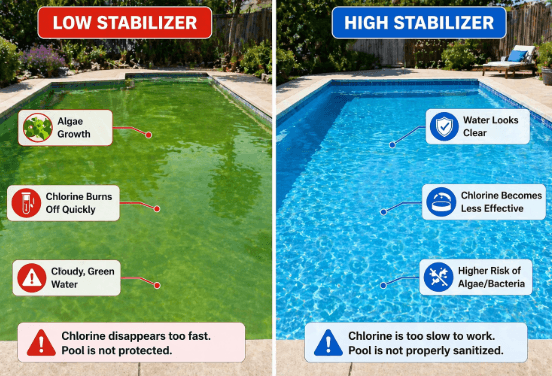
Low stabilizer means your chlorine has no protection from the sun.
So what happens?
- Chlorine burns off within hours
- You keep adding chemicals, but see no results
- Water can turn cloudy or green quickly
Now the other side…
High stabilizer means there’s too much cyanuric acid (CYA) in the water.
This slows chlorine down too much.
- Chlorine becomes less effective at killing bacteria
- You may see algae even when chlorine levels look “normal.”
- Water feels harder to balance
Most of the time, high stabilizer happens from overusing chlorine tablets or adding stabilizer too often without testing.
In short:
- Too low = chlorine disappears
- Too high = chlorine stops working properly
How Much Stabilizer Should a Pool Have?
There’s a sweet spot you want to stay in. For most pools, the ideal stabilizer level is:
30 to 50 ppm (parts per million)
This range gives chlorine enough protection without slowing it down.
Here’s a quick idea based on pool size:
- 10,000 gallon pool → around 2–3 pounds of stabilizer (to reach proper levels)
- 20,000 gallon pool → around 4–6 pounds of stabilizer
Important thing to understand:
You don’t just dump a fixed amount every time. You adjust based on your current stabilizer level.
Always test first before adding anything.
How Much Stabilizer to Add to a Pool
This depends on how low your current stabilizer level is.
A general rule:
To raise the stabilizer by 10 ppm, you need about
13 ounces (by weight) per 10,000 gallons of water
Example:
- If your pool is at 10 ppm and you want to reach 40 ppm
- You need to raise it by 30 ppm
- That means adding roughly 39 ounces (~2.5 lbs) per 10,000 gallons
For a 20,000 gallon pool, just double that amount.
The key is:
- Test your water
- Calculate the difference
- Add stabilizer slowly
Adding too much at once is a common mistake and hard to fix later.
📖 You May Also Like This “Swimming Pool” Article: Can You Get a UTI From a Swimming Pool?
How to Add Stabilizer to a Pool
Adding stabilizer the right way matters. If you just dump it in, it won’t dissolve properly.
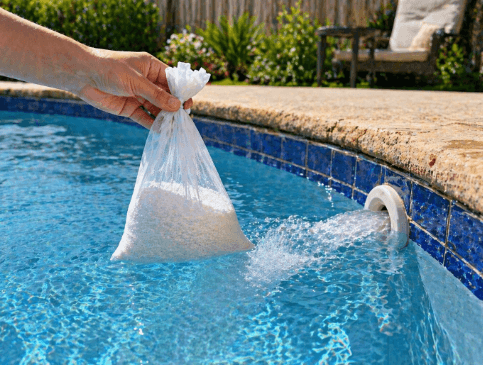
Here’s the simple method most people use:
Step 1: Use the sock method
Put the granular stabilizer into a sock or a cloth bag.
Step 2: Place it in the pool
- Hang it near a return jet, or
- Place it inside the skimmer basket
Step 3: Let it dissolve slowly
- Don’t pour it directly into the pool
- It can take 24–48 hours to fully dissolve
Step 4: Keep the pump running
This helps circulate the chemical evenly.
Step 5: Retest after 2–3 days
The stabilizer doesn’t show up immediately on tests. Give it time before adjusting again.
If you’re using liquid stabilizer, you can pour it directly into the pool, but always follow the label instructions.
Quick tip: Never add too much stabilizer at once. Unlike chlorine, it doesn’t go away easily.
How to Dissolve Pool Stabilizer
To dissolve pool stabilizer, don’t dump it directly into the water. Put the granular stabilizer into a sock or cloth bag, then hang it near a return jet. Keep the pump running so water flows over it. It usually takes 24–48 hours to fully dissolve.
How to Add Stabilizer to Pool Without a Skimmer
If your pool doesn’t have a skimmer, use the sock method instead. Fill a sock with pool stabilizer and hang it in front of a return jet or place it in the pool where water circulates well. This helps it dissolve evenly without settling on the pool floor.
How to Raise Stabilizer in a Pool
If your stabilizer is low, chlorine won’t last long. The fix is simple, but you need to do it carefully.
The main way to raise it is by adding cyanuric acid (CYA), which is your pool stabilizer.
Here’s how to do it right:
- Test your water to check the current stabilizer ppm
- Calculate how much you need to reach 30–50 ppm
- Add granular stabilizer slowly using the sock method
- Keep the pump running for proper circulation
- Wait 2–3 days, then test again before adding more
Example: To raise stabilizer by 10 ppm, add about 13 oz per 10,000 gallons.
Important: Don’t rush this. Adding too much stabilizer is a common mistake, and it’s much harder to lower than to raise.
How to Lower Stabilizer in a Pool
High stabilizer can make chlorine weak, even if levels look fine.
The most effective way to lower it is:
Partially draining and refilling the pool
This dilutes the cyanuric acid and brings levels back down.
Other things that can slowly reduce stabilizer:
- Backwashing your filter
- Splash-out from regular use
- Rainwater dilution
But these methods are slow and not reliable if levels are too high.
If your stabilizer is way above 50–60 ppm, a partial drain is usually the fastest fix.
How to Lower Stabilizer in Pool Without Draining
Lowering the stabilizer without draining is limited, but a few options can help. You can try using a pool water replacement system if available, which swaps water gradually. Some people also use CYA reducers, but results can be inconsistent and slower than expected.
In most cases, natural dilution over time (rain, splash-out, backwashing) is the only non-drain option.
When to Add Stabilizer to a Pool
You don’t need to add stabilizer all the time. It’s something you adjust only when needed.
Add stabilizer when:
- Your test shows levels below 30 ppm
- You’re opening your pool for the season
- You’ve recently drained or refilled a large amount of water
For most pools, stabilizer doesn’t get used up quickly. So instead of adding it on a schedule, just:
Test your water regularly and adjust only when needed
This keeps your chlorine working properly without overloading your pool.
Can You Swim With Stabilizer in the Pool?
Yes, you can swim once the pool stabilizer has fully dissolved and water is circulating. Just make sure levels are in the safe range (30–50 ppm), and chlorine is balanced. Avoid swimming right after adding the granular stabilizer.
Does Pool Shock Have Stabilizer?
Some types do. Dichlor and trichlor shock contain stabilizer (cyanuric acid), while calcium hypochlorite (cal-hypo) does not. Always check the label, because using stabilized shock can slowly raise your stabilizer levels.
Is Pool Stabilizer the Same as Shock?
No, they’re different. A pool stabilizer protects chlorine from sunlight, while shock is a high dose of chlorine used to clean the pool quickly. One helps chlorine last, the other boosts it temporarily.
Does Baking Soda Stabilize Pool Water?
No, baking soda does not act as a stabilizer. It raises alkalinity, not stabilizer levels. To protect chlorine, you need cyanuric acid (pool stabilizer) specifically.
How to Raise pH, Alkalinity, and Stabilizer in a Pool?
Each one is adjusted separately. Use soda ash to raise pH, baking soda for alkalinity, and pool stabilizer (CYA) for stabilizer levels. Test your water first, then adjust each level step by step to avoid imbalance.